The Living Interface Beneath Your Skis
Snow is not a static surface waiting beneath your skis. It is an active crystalline medium that changes hour by hour as temperature, moisture, wind, sunlight, and pressure reshape the bonds between grains. Fresh flakes can create a deep, low-density layer that welcomes a track with gentle resistance. A few hours of wind can turn that same snow into a cohesive slab. An overnight freeze can lock moisture into a firm riding surface that demands accurate ski pressure and deliberate throttle control.
That changing interface is often mistaken for a chassis problem. A sled that feels heavy to steer may not need a new suspension setting; it may simply be working against dense, refrozen snow. A machine that darts or washes sideways may be reacting to carbide engagement on hardpack rather than a mechanical fault. To ride with confidence, connect snow science to the controls in your hands. Read the surface, predict how it will load the track and skis, then make smooth changes in body position, throttle, and steering before the terrain makes the decision for you.
Anatomy of the Snowpack from Flakes to Hardpack
New snow begins as precipitation particles with shapes determined by the atmosphere. Once on the ground, those particles continuously metamorphose. Temperature gradients can drive faceting, creating angular grains with weak bonds. More uniform temperatures encourage rounding, which generally produces stronger contact between grains. Wind can break and transport crystals, packing them into dense, cohesive layers on lee slopes. Melt-freeze cycles then alter the surface again, producing hard crust, icy patches, or a firm corn-like layer that may soften in direct sun.
Density matters because it determines how readily the snow deforms beneath the track. Unconsolidated powder offers low strength and allows the track to sink until enough snow is displaced to support the sled. Dense windboard resists initial penetration but may fracture abruptly when the load exceeds its strength. Hardpack provides little flotation but substantial support, allowing the skis and runners to transmit force directly into the surface. The result is a constantly changing balance between flotation, rolling resistance, ski bite, and side-to-side stability.
The avalanche safety glossary explains how faceting, sublimation, deposition, and melt-freeze processes transform snow layers. For riding purposes, the key lesson is that a visually smooth surface can conceal very different mechanical behavior. Use the following comparison as a practical field guide rather than a substitute for direct observation.
| Snow condition | Typical character | Approximate density | Effect on the sled |
|---|---|---|---|
| Fresh dry powder | Loose crystals with weak bonding | About 30 to 100 kg/m³ | Strong flotation demand, high trenching risk, light ski bite |
| Settled powder | Rounded grains with increasing cohesion | About 100 to 250 kg/m³ | More support and predictable resistance, but still dependent on track width |
| Wind slab or wind crust | Dense, cohesive, sometimes brittle layer | About 200 to 400 kg/m³ | Initial support followed by sudden break-through or uneven loading |
| Hardpack or refrozen snow | Firm, compacted, often abrasive surface | About 350 to 550 kg/m³ | Strong ski and carbide engagement, limited flotation, greater darting potential |
Floating Through Bottomless Powder and Sinking Transitions
In deep powder, the track acts like a moving support platform. Its width, length, lug profile, and contact area determine how much pressure reaches the snow. A longer or wider track distributes the sled”s weight over more surface, while aggressive throttle increases the shear force that tries to excavate a trench. Once the track spins faster than the snow can support, it digs down, builds a berm behind the machine, and loses the momentum needed to climb onto the surface.
Conventional trail steering also becomes less effective because the skis are not working against a firm lateral platform. Turning the handlebars sharply can bury a ski rather than redirect the sled. Counter-steering, throttle management, and rider position become the primary control axes. A small change in lean can shift the track and ski loading enough to alter the sled”s direction, while a controlled increase in throttle can keep the machine moving across the top of the snow instead of sinking through it.
When navigating deep mountain terrain, mastering precise weight distribution and responsive throttle control allows riders to stay up on plane without trenching into unsupportive base layers. That principle applies to experienced backcountry riders and rental customers leaving a groomed trail for the first time. Smoothness is more valuable than force. Keep the engine pulling, avoid abrupt steering corrections, and let the chassis rise onto the snow before asking it to change direction.
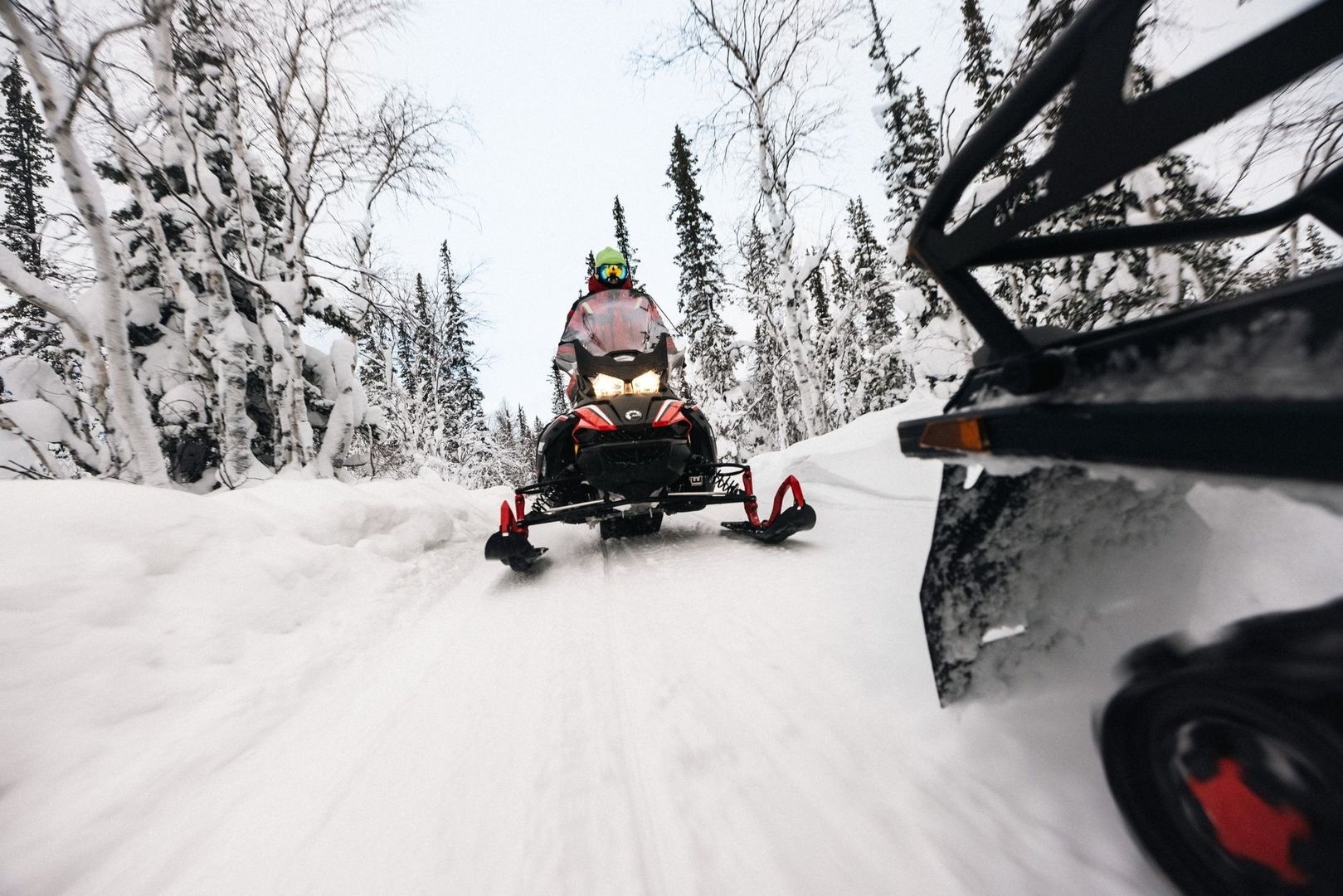
- Keep your weight slightly forward when entering a soft pocket, then move rearward progressively if the skis begin to dive.
- Use steady throttle instead of repeated bursts that create track spin and a deep trench.
- In sidehill terrain, lean the upper body uphill while allowing the sled to remain aligned with the intended traverse.
- Approach packed tracks at a shallow angle and reduce steering input as the skis climb onto firmer snow.
- Check the snow ahead for texture changes, depressions, tree wells, and hidden hard layers before accelerating.
Taming Wind Crust and Breakable Slabs
Wind scouring removes loose snow from exposed ridges and transports it toward sheltered slopes. There, broken crystals can settle into a dense slab. The slab may feel supportive for several feet, then crack or collapse when the track, ski, or rider weight exceeds its strength. Sun crust behaves differently but creates a similar handling problem. A warm, moist surface freezes into a shell, while softer snow remains underneath. The sled may ride smoothly on top until one ski punches through, suddenly increasing resistance on that side.
A breakable crust can produce a sharp yaw or washout because the two skis are no longer experiencing equal support. One ski stays high on the slab while the other drops into softer snow. The handlebar may pull toward the sinking side, and the track can momentarily lose alignment as resistance changes. The safest response is usually a calm reduction in steering angle, stable throttle, and a deliberate body shift that keeps the machine from tipping into the unsupported side. Avoid sudden braking on an uneven slab, since weight transfer can make the front end more vulnerable to digging in.
Wind-loaded snow also deserves avalanche attention, not only handling attention. A hard surface may indicate a cohesive slab over weaker faceted or loose grains. The avalanche glossary describes persistent slabs and near-surface facets as problems that can be difficult to identify from the surface. Treat steep wind-loaded terrain with appropriate caution, use current local forecasts, travel with a capable group, and carry functional rescue equipment and training. Mechanical confidence never replaces terrain management.
- Scan for wind texture, scalloped drifts, smooth pillows, and abrupt changes from soft snow to firm board.
- Reduce speed before crossing the transition, keeping the sled straight and the throttle steady.
- Keep your elbows relaxed and allow small chassis movements instead of fighting every vibration.
- If a ski breaks through, shift smoothly toward the supported side, maintain enough momentum to avoid a stall, and straighten the machine.
- On steep or loaded slopes, stop and reassess the route rather than using throttle to force through an uncertain slab.
Mastering Ski Bite and Slide-Slip on Hardpack
Hardpack changes the sled”s physics from flotation to edge engagement. The carbide runner must penetrate a firm surface to generate lateral grip. When both skis bite evenly, the machine tracks cleanly through a turn. When one runner engages more aggressively, the sled can dart, pull, or demand heavy handlebar effort. Chassis roll also becomes more noticeable because the snow offers enough resistance to transmit steering and suspension forces directly into the rider.
Runner depth, ski pressure, alignment, suspension balance, and snow temperature all influence the result. More carbide generally increases bite, but maximum engagement is not automatically best. Deep runners can make steering tiring on a firm trail and may amplify darting if the skis are not balanced. Adjustable systems such as the Ski-Doo Pilot TS design allow the carbide to be extended for more grip or retracted to reduce bite and wear. Any adjustment must be made evenly on both skis, with the settings recorded so the sled remains predictable.
Before a hardpack trip, inspect runner wear, ski alignment, and suspension settings. If the trail is icy, begin with conservative speed and test braking and turning in a clear area. On steep refrozen sidehills, a controlled slide-slip can be safer than trying to force the skis to hold a perfect traverse. Keep the uphill side of the body active, maintain a consistent throttle, and use small steering corrections. A slide should be intentional, limited, and pointed toward a safe escape line, never allowed to develop into an uncontrolled downhill acceleration.
- Use equal carbide settings on both skis and verify that the runners are not worn unevenly.
- Reduce excessive ski pressure if the sled feels twitchy or darts across ruts.
- Keep your eyes on the exit of the turn, not directly at the obstacle or rut you are trying to avoid.
- Use the throttle to stabilize the chassis during a sidehill slide, while avoiding sudden acceleration that can break the track loose.
- On icy descents, leave extra stopping distance and avoid abrupt handlebar inputs.
Sharpen Your Terrain Instincts on Every Mountain Mile
Reliable control begins with active visual reading. Watch for the matte texture of dry powder, the polished shine of refrozen snow, wind ripples, supportable slabs, and dark depressions where the track has already broken through. These details tell you how much resistance to expect before the skis arrive. As the surface changes, adjust your body position, steering pressure, and throttle continuously rather than waiting for the sled to react.
Daily freeze-thaw cycles and wind patterns turn a familiar route into a different mechanical puzzle each morning. A trail that was soft and forgiving yesterday may be firm and abrasive after an overnight freeze; a sheltered meadow may hold powder while an exposed ridge carries a brittle wind crust. Prepare for those changes with a machine check, suitable clothing, current terrain information, and a realistic pace for the least experienced rider in the group. When the snow is treated as a living surface rather than a uniform road, tricky terrain becomes more readable, more manageable, and far more rewarding.